"Sharing the words and passions of the single and multisport enthusiast"

"The lure of the distant and the difficult is deceptive. The great opportunity is where you are."
John Burroughs

TRIATHLON - SWIMMING - BIKING - RUNNING

(See ViF content index sidebar below - Quotes, Training Videos, and Articles of Interest)

ViF - Featured Motivational Quotes


"Ability is what you're capable of doing. Motivation determines what you do. Attitude determines how well you do it."
Lou Holtz - College Coach Great


"If you set a goal for yourself and are able to achieve it, you have won the race. Your goal can be to come in first, to improve your performance, or just to finish the race - it's up to you"
Dave Scott - Six Time Ironman World Champion

Showing posts with label Articles - Swimming. Show all posts

Tips for putting on your wetsuit.

Are You Sure You're Putting On Your Wetsuit Right?
The Human Shoehorn

By Swim Smooth


There is a bit of a secret method to getting in your wetsuit properly, we call it the "human shoehorn". You'll need some help from a friend to use this technique but it will make your suit a lot more loose and flexible around the shoulders.

The first step is to make sure that you pull enough loose material up the arms and legs. Use a plastic bag over your hand or foot as you slide them into the suit, this helps the suit slip on. At the ankles and wrist pull your suit up 5cm (2 inches) more than you might normally do:


Work this material up your legs to the groin area and up your arms to the shoulders:

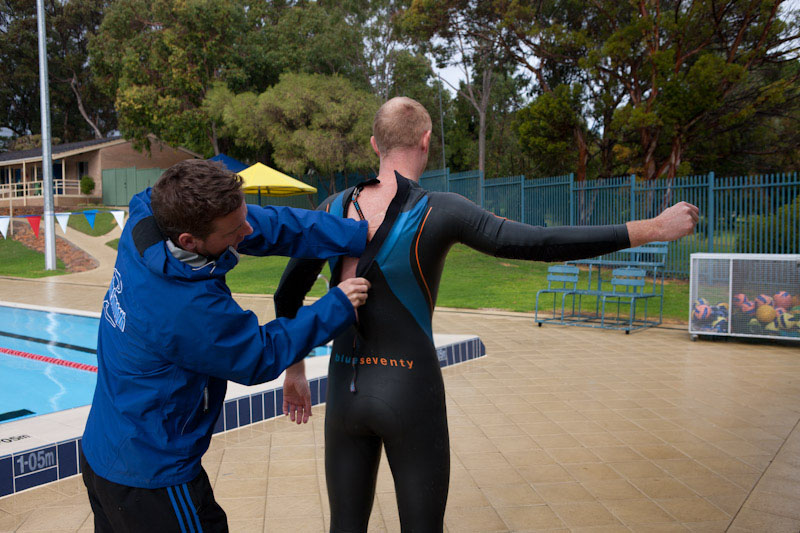
Now have your friend slide their hand inside the suit down towards your tricep and with their other hand work the material up the arm and round from the chest on both sides. This is the "human shoehorn"

Take care not to over-stress the suit doing this as you might tear it. You're just trying to position the suit nicely on your body, not stretch it. The last thing you want to do is rip your suit immediately before a race!

   Without using this method you will have a wide gap across your back between the zip and when you do up your suit it will compresses your shoulders and makes things very tight. After Human Shoehorning your suit will sit quite differently with the zip almost together on your back, which can be easily done up:

Now your shoulders will be much more free and loose, ready for a great swim split!

Open Water Swimming - New magazine launch


If you enjoy (or even only do open water swimming as leg one) OWS you might want to add this new, UK based, Open Water Swimming magazine to you reading list.

H20pen open water swimming 


In next month’s issue -
   * Keri-Anne Payne’s open water swimming tips
   * Five ways to swim faster without training harder
   * How to train now to race well this summer
   * Plus classic swim series, the country’s best lidos, race listings and gear reviews

Subscriptions @ H2Open

Off Season Swim Training - 3 Exercises to Strengthen the Shoulders

     With the multisport season winding down in most areas of the US many triathletes are now thinking of working on improving their swim stroke, and will be spending more time in the pool over the winter months.
     To help you strengthen your shoulders and lessen risk of an overuse injury here are three exercises, shared by trainer LaRue E. Cook of LEC Fitness through Active.com Fitness , to strengthen those shoulders.

#1 "Empty the Can"
This exercise will help work the muscles of your upper back and shoulders. These muscles are instrumental in raising your arm in overhead movements. I recommend using a light weight for this exercise, from two to five pounds.
Start
Stand with your feet about hip-width apart, with relaxed knees (your "relaxed stance"). Hold a single dumbbell in your hand. Place your thumb-side against your thigh.

Exercise
Lift your arm up and out at about a 45-degree angle from your body, pointing your thumb-side down toward the ground as you lift. Think of pouring out a can of soda. Keep your wrist firm (don't bend it as you exercise).

Lift up to shoulder height, pause for a second or two, and then return to the starting position.


Tip: Don't have a small weight at home? Use an actual can of soup or a filled water jug with a handle.

#2 "Draw the Sword"
This is a good exercise for the rotator cuff, one of the shoulder's potential trouble spots.

Start
Start in your "relaxed stance" as mentioned earlier. Place a light dumbbell in one hand and place that hand, palm down, on the opposite thigh (for example, put the thumb of your right hand on your left thigh). Keep your arm straight throughout this exercise.

Exercise
Draw your arm across your body (out and up to above your opposite shoulder). Once your hand has reached a level above your shoulder, return to your starting position.


Perform this exercise slowly. Complete 12 repetitions, and make sure you switch arms.

#3 "Medicine Ball "Alphabet"This is a great exercise to put your shoulder muscles through a full range of motion. This one can be tough, so start out just by going partially through the alphabet, and then work your way up to the full A through Z.

You'll need a medicine ball for this exercise, but don't worry if you don't have access to one. Use something like a gallon jug that's partially to completely full, or fill a bag with sand and weigh it (say one to four pounds, depending on your shoulder strength).

Start
Start in a "relaxed stance." Take the medicine ball and support it in both hands out in front of your body.


Maintain a slight bend to your elbows throughout this exercise.

Exercise

Start "drawing" the alphabet one letter at a time. You do this by rotating your arms,
from the shoulders only, in the pattern of the specific letter, starting with the letter A. Make nice big, full letters with big motion so that your shoulders get lots of work and a full range of motion.


When you first start doing this exercise, it's best to start with a very light weight (say one or two pounds at the most) to see how your shoulders tolerate this exercise. Your letters should range no higher than your head, and no lower than your waist. All letters are formed out in front of your body. Keep those arms straight, with just a slight bend at the elbows.

As with all exercise programs, always check with your physician and a certified conditioning specialist before undertaking any of these exercises.

For more information on LaRue E. Cook and his training programs visit lecfitness.com

Summer heat is here... Time for Hydration 101

Hydration 101
  article excerpt by Infinit "The First & and; Last Word in Sports Nutrition"

   Do you know how much you should be drinking to stay hydrated
during training or racing?

   Infinit explains a trend it has seen over the past couple of years, the issue...
"Athletes have no idea exactly how much they should be drinking in order to stay hydrated. It is a HUGE component of how you will perform. If you lose 2-3% of your body weight in water loss you will lose 5-15% of your watts (power output). For an athlete that weighs 150 pounds, only a few pounds that will make the difference between a solid result and potential disaster.

Salt does not prevent dehydration or cramping. That is the stuff of urban legend. Salt is a transporter of fluids. You need salt, but only enough to move water out of your gut into your system. The movement of water is the key to prevent dehydration and possibly cramping issues. If you are not drinking enough, I don’t care how perfect your formulation is, you might be in for a long day. For most males the target should be around 375 mg of sodium per hour and females around 325 mg. It should be a blend of electrolytes containing sodium, potassium, magnesium and calcium. To reiterate, salt is a transporter. You don’t have to overdue electrolyte intake. You only need enough to move the liquids you are putting into your system.

There are two things that you must have in order to train and race efficiently.

DO A SWEAT RATE TEST! How are you going to know how much you need to be drinking if you don’t have a handle on how much you are sweating? Remember, no product in the world is going to prevent you from dehydrating if you are not drinking enough. Your hydration target will vary somewhat depending on the heat and humidity, but this is a crucial component to race day performance.

• Before your workout empty you bladder, and record your weight
• Record how much you drink during the workout
• After the workout, re-empty your bladder and re-weigh yourself
• Take the weight you lost, ADD the amount you drank, then divide by the number of hours you worked out.

That will give you an hourly hydration target. I would do it a few times to have an average. Your hydration target will need to be adjusted somewhat for heat and humidity. But this is key information for performance.

Calorie and electrolyte intake (in a form that is isotonic). Most athletes perform better by not overdoing calories and salt. Rule of thumb is 2 calories per pound of lean body weight. Obviously some people need more and some people need less. Long distance racers typically need more calories per hour than sprint racers. But these are solid starting points based on working with thousands of athletes.

So there it is. With those these small pieces of information you can have a great race.

• Know how many calories per hour you need
• Know how much you need to be drinking per hour
• Put your nutrition in a form that is isotonic

It does not have to be complicated. Remember simple and repeatable. Follow those simple steps and you will perform the way you want with no nutritional issues."

See this full article and many other great nutrition tips and training articles at Infinit Loop

Should I be using a Coach... Do I really need one?

Attending a recent Northeast Multisport Expo ViF noticed one of the largest exhibitor categories was that of coaching and coaching related services.
One might think, "Wow, so many coaches and coaching programs or methods!
Can't an athlete just train on their own, do they really need a coach to tell them what and when to do things?"

The answer is Yes and No, as always, it depends.

ViF - Victory is Finishing is about finishing...but you define "Finishing".

Are you at the stage of your journey where "Finishing" to you is now more than reaching and crossing the finish line?
Has "Finishing" become defined more by how quickly you reach that finish line? Do you have a certain finish time or goal you want to achieve this season?

Could a tri or running club, strong training partner, or a coach help you reach your goals?

Kerry Sullivan of  Rock Star Triathlete Academy
might help you answer that question with his recent article -

What's the Point of a Coach?    

"I truly love coaching, and I believe it is important for everyone, even coaches, to work with a coach. I believe in this so strongly that I work with two coaches: one for swimming, and one for overall triathlon training. Yes, I am a certified coach and experienced athlete in all types of endurance sports, and yet I still utilize coaches.

Why?

1. Often, people can become so focused on moving in a particular direction that they do not even realize that they are headed the wrong way. Needless to say, I have done this and, as a result, I have run myself into the ground, even though I knew better. A coach can stand back, look at things from a fresh perspective, and help the athlete to realize that a different direction is needed. This is the same reason why many corporations hire consultants -- to help them run their companies better.

2. I love to read about top performers in all different areas, from business to sports. Most top performers employ coaches and or mentors, even though they already have a great deal of knowledge. Tiger Woods, for example, is very knowledgeable on golf, yet he still has many people around him who assist him with all areas of his game.

3. I once read that the two things that will have the most impact on a person's life are the books a person reads and the people with whom he or she chooses to associate with. If a person wishes to develop more strength in a particular area, it is a good idea to surround oneself with knowledgeable and experienced people. That is why many top athletes have coaches, nutritionists, strength and conditioning coaches, and strong training partners.

Long Course Triathlon Training - for a "Real Person" in the "Real World"

Victors' Rich Strauss and Patrick McCrann share Long-Course Triathlon Training for the "Age Grouper" and "Real Life"
(A three part series worth the read!)

5 Keys to Long-Course Triathlon Training: Part I - The focus you put on your training will determine how prepared you are at the start line.

By Rich Strauss and Patrick McCrann of Endurance Nation

We'd like to share with you our distilled summary of what long-course triathlon training is all about, learned from our nearly 20 years of long-course training, coaching and racing experience. Our goal is to bring you years and years up the learning curve, saving you tons of time and experimentation. In short, we've made all of the mistakes so you don't have to.

In Part I we'll discuss keys one through four. In Part II we'll discuss the fifth key. Finally, in Part III we'll contrast our approach with the conventional long-course training wisdom.

The Five Keys are entirely a function of the need to both maximize and reserve your training time investment for as long as possible to meet real world constraints.

Everything we do—the workouts, the structure, everything—flows backwards from the fact that you are an age-group athlete living in the real world. Period. We feel very strongly that any discussion on how to train that does not begin, in the first sentence, with defining how much time you have to train, is largely invalid.

In other words, we can't talk about what goes in your training box without first talking about how big your box is.

Life - not a spreadsheet, not a coach, not a book—dictates the size of that box. This is an absolute, do-not-pass-go thing you gotta get through your head. This is all just a game and it must fit within your life.

Endurance Nation's -

Five Keys of Long-Course Training

1. Real-World Volume

2. Maximize Return on Time Invested

3. Fitness = Ability to Perform More Work

4. Intensity = Most Flexible Tool to Manipulate Training Load

5. The Best Predictor of Performance is Pace/Watts at Functional/Lactate Threshold

Breathing in Freestyle: How To Stop Choking On Water

Breathing in Freestyle: How To Stop Choking On Water
by Brenton Ford - Effortless swimming from The Land Down Under

Swimming can be a difficult sport to learn if you’ve never been taught the very basics. One of the biggest issues most beginners face is breathing in the freestyle stroke. Even for veterans of the sport, breathing can be a nightmare if you don’t know the correct technique and method for easy and effortless breathing in freestyle.

The prospect of swallowing water can stop people from learning swimming as it can all seem too difficult after they’ve given it a shot three or four times. If you are having breathing problems in your swimming, don’t despair. There is an easy solution which can be implemented right away. Here I will outline the three keys to overcoming breathing problems in swimming.

1. Breathing out -
The most important aspect of breathing technique is the breath out. The reason most swimmers choke on water is because they blow out all of their air too early or too late. The swimmer should breath to the side of the recovery arm (the arm which is out of the water) and take a big breath of air. As the head enters the water, begin blowing a small amount of air out of both the nose and the mouth. Continue doing this until just before you take your next breath. As you go to breath again let all your air out quickly through your nose and mouth just before you take that next breath. Remember that last sentence and your breathing problems should be fixed.

2. Rotation -
To breath effectively it’s necessary to breath to the side. The easiest way to do this is to rotate the shoulders throughout the freestyle stroke. This makes it easier to get the mouth out of the water so not as much head rotation is required. Use your body roll and momentum to help rotate your head when breathing.

3. Stay relaxed -
A secret to effortless swimming, not just effortless breathing, is to stay relaxed. Too often swimmers will tense up, hyperventilate and force themselves through the water. This isn’t how to swim fast. You must stay relaxed, keep calm and allow yourself to glide through the water. During your breathing, keep calm and allow yourself to breath normally without forcing air in and out.

There you have it, three important tips which will help you breath easier in freestyle. Remember to let all of your air out quickly through your nose and mouth just before you take a breath. Use your body roll and momentum to help rotate your head when breathing, and stay relaxed and breath normally though out the stroke.

Improve Swim, Bike, Run, Endurance - Victors' shared words

How to Create Your Own Interval Workouts

by Jessi Stensland - professional triathlete, movement specialist and
creator of MovementU

Having a specific purpose to each of your workouts is key. Interval training is a great way to help you achieve specific improvements as you work to reach your true potential.

Here is a great example of an interval progression with a basic premise that can be applied to any endurance sports, whether it be swimming, biking or running. It has two goals that are key to increasing your capacity to do work when you train and race:

1. Increase anaerobic threshold

2. Increase leg speed

By improving both your anaerobic threshold and your leg speed, you will increase your endurance for longer distances. The workout involves short, intense intervals followed by a period of rest, and takes into account this work-to-rest ratio.

With increased fitness over time, the intense intervals will get longer and the rest needed will get shorter.

    Choosing your speed — You'll want the intense intervals to challenge you beyond your current anaerobic   threshold, taking you very close to your maximum effort for each interval.

    Choosing your rest — You'll want to take enough rest to be able to continue to perform the hard intervals well throughout the set.

The Workout

After a dynamic warm-up and about five minutes easy of whatever sport you're doing, begin the workout with a one-to-one work-to-rest ratio.

Should I wear a wetsuit for a sprint Triathlon? - Victors' shared (humorous) words.

I Tested Positive for Neoprene But My Wetsuit Doesn't Think I Suck  
by Ismael Rodriguez


This story originally appeared in Mindset Triathlon's Triathlon's Toughest Sport: True Stories Told by Triathletes Making Their Case for the Swim, the Bike or the Run.

Victors' Shared Words -

I'm a new 'swimmer'. I state that as such because what I do in the pool hardly constitutes swimming. I decided to enter into the wonderful world of triathlon last year when I signed up for the Nautica New York City Triathlon. I felt there was plenty of time to learn how to swim in time for the July 2008 event. All I had to do was temper my fear of the deep water, learn the front crawl, and be competent enough to eventually look like the 'other' competitors, you know blend right in like I'd been doing this for a long time.

Well, November rolled by, so did December and so on... then I woke up one day in April and realized, "holy crap, you gotta learn how to swim, dude."

I eventually signed up for an adult swim class and was immediately struck with a sense of dread - "I can't do this." My fears were confirmed after the second class when I came to the stark realization that I suck at this. I was classified as a 'sinker' - my legs were about as buoyant as a sack of potatoes - the industrial sized pack. Undaunted, I soldiered on and with each class I got, well, worse. I decided to cycle to the pool weekday mornings before work. A 5:00 a.m. start, get to the pool at 5:30 a.m. Empty lane lines and a chance to strut my stuff without the embarrassment of the noisy splashes to disrupt the other real swimmers.

Then it happened: I completed a full lap. 25 meters without stopping.

One problem however: it was a week before the Nautica New York City Triathlon. But after that triumph of the lap I declared myself ready. So here was the deal: I'd done one full lap on my own and I felt I was ready to take on the mighty Hudson River and 1,500 meters!!! Note to self, there's a Visa commercial here:

Swim skills: 0.
Open water experience: 0.
Stupidity: Priceless.
Yes, stupidity, that one intangible that sets me apart from your average, run-of-the-mill triathlete - if there exists such a person. Now I was not completely incompetent. I had an ace in the hole. I'd done some homework on wetsuits. I'd read everything I could and asked a few experienced athletes the same question: "How buoyant is a wetsuit?"